top of page


Guided by Ice · Grounded in Community
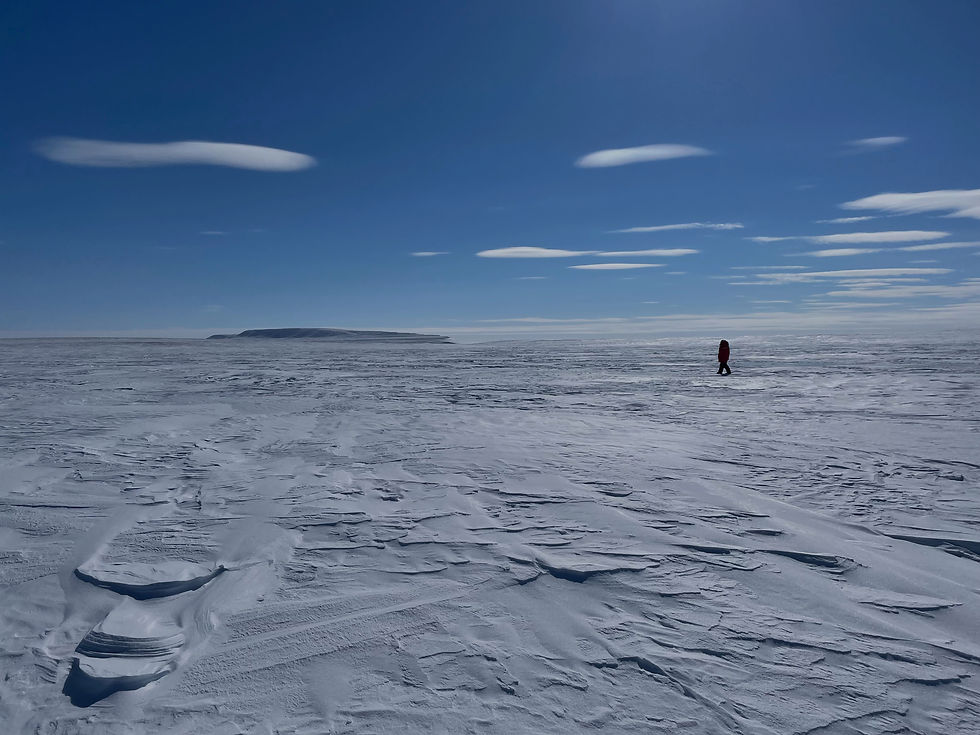
Ovayok Park - Mont Pelly
FROST brings together indigenous knowledge, natural sciences, and social sciences to understand how warmer winters are transforming Arctic lakes and cultural practices.
Fieldwork
Explore our recent fieldwork across the Arctic, highlighting the many sites involved in our broad-scale study.


Recent News about our activities


A Field Diary from Lake Muddusjärvi : Nets, Coffee, and Burbot
Helena, a Master’s student from Finland, recently spent a week at one of the FROST study lakes conducting interviews to better understand how warming winters are affecting local communities. During her visit to Finnish Lapland, she also joined fishers on the ice and took part in fishing and gutting, gaining firsthand insight into daily practices and changing conditions. She has kindly agreed to share some of her experiences with us. My fieldwork at Lake Muddusjärvi included
il y a 1 jour


Cold temperatures, strong partnerships
Last week, temperatures plunged to –50 °C in Cambridge Bay and our incredible field collaborators from the Canadian High Arctic Research Station (CHARS) Shannon, Jasmine, Layla, and Spencer were out on the ice measuring thickness and collecting temperature/conductivity profiles in Lakes Greiner and Pelly. This work shows the power of long-term partnership between researchers, communities and Polar Knowledge Canada. By building research with Inuit communities, we strengthen ye
5 févr.


A late start to winter: FROST’s first campaign in Norway
A team of scientists from Norwegian Institute for Nature Research (NINA) and the Norwegian Institute for Water Research ( Akvaplan-NIVA) just carried out the first field campaign for the FROST project. The project's main study location in Norway is Takvatnet, a large lake located 2 hours drive southeast of Tromsø city. Due to an extraordinarily mild autumn, the ice formation at Takvatnet that usually occurs during November, was very late this year. This delayed the first c
18 janv.


Winter sampling of Lake Kilpisjärvi
The first ice sampling at Lake Kilpisjärvi, northern Finland, happened during December 2025. The lake is located at 69° N, experiencing nearly two months without direct sunlight, with the sun lingering just below the horizon and providing a few hours of beautiful twilight each day. Whole lake had frozen couple of weeks earlier and 33 cm of clear ice with some 10-20 cm of snow made snow mobile logistics easy. “Sampling of benthic invertebrates at -30 degrees celsius is a perf
16 janv.


ArcticNet 2025 in Calgary: Listening to Northern Voices, Building Hope for the Future
Last December, members of the FROST community gathered in Calgary for the ArcticNet Annual Scientific Meeting , one of the most important events bringing together people dedicated to understanding Arctic life and the challenges it faces. Thousands of participants attended, and what made this meeting especially powerful was that nearly 40% of attendees were Northerners . Their presence, leadership, and voices shaped the conversations throughout the week. FROST Research group w
9 janv.


When winter is late: News from Cambridge Bay
Last November, a team from the international research consortium FROST, led by Milla Rautio at the Université du Québec à Chicoutimi, returned from Cambridge Bay in the Canadian Arctic… with the observation that winter had not yet arrived. Credit: Shannon Evetalegak - The ‘’Frosties’’ Sara, Félix and Milla after sampling It’s an unusual season, a late autumn. The formation of the ice cover is nearly three weeks behind schedule. There’s no snow yet either, but this absence all
12 déc. 2025
bottom of page


