
Our recent field campaign went a little more smoothly than the ATV trails in Cambridge Bay! (Part 2)

August 2026
We sampled Pelly Lake on a perfect 15°C day, with blue skies and barely a breath of wind. We had the pleasure of bringing two Elders from the community, Navalik and her friend Josie, out on the land to enjoy the beautiful weather.
After a very bumpy truck ride, they set up their camping chairs in the tundra, facing the lake, and spent the day watching us search for insects and fish with our one remaining working motor, while sharing stories and laughing together.

Meanwhile, Brodie, a local filmmaker, joined us with his mom to capture footage of this beautiful day for the short documentary we are preparing. We caught several lake trout and Arctic char, from which we took some measurement and then returned to the Elders. It was one of those perfect field days.


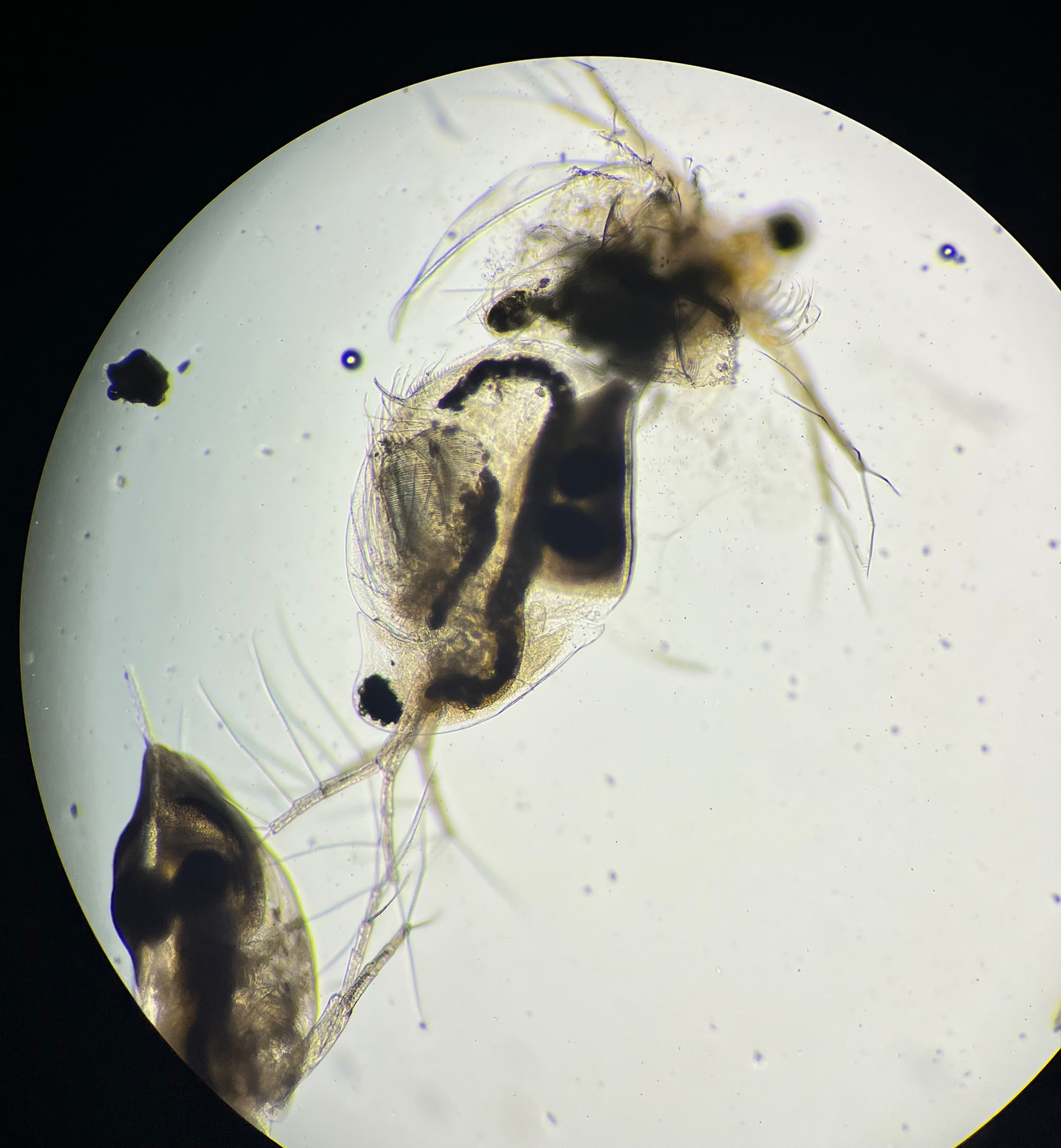
The following days, we headed to Inuhotok Lake, where millions of Daphnia eggs covered the shoreline, leaving a dark coating on the rocks. Daphnia can reproduce asexually when conditions are favourable, but can switch to producing sexual eggs when environmental conditions become less suitable. Could the unusually warm and early summer have triggered this shift?



That same day, our multiparameter probe revealed something we had never observed before at this lake: the water column was stratified. Deep Arctic lakes in the tundra are generally expected to remain well mixed because of cold temperatures and persistent winds. But this summer seemed to be changing the rules. Data from cameras installed in nearby lakes showed ice disappearing as early as June and water temperatures reaching 25°C by mid-June. That's extreme for the High Arctic !
We returned the next day to retrieve the mooring and installed a camera trap to monitor future ice-on and ice-off events. And before heading back, we couldn't resist taking a quick dip in the lake. Refreshing is an understatement!


As the week came to an end, we installed a fishing net in Greiner Lake around midnight. With the sun still glowing over the horizon and the lake completely calm, it was a magical way to end the sampling day.
We also shared tea with Navalik, listening to her stories related to the beautiful jewelry she showed us. She later offered Milla, the FROST project lead and a longtime friend, a beautiful traditional knitted hat featuring an ulu.
And to top it all off, we ended the trip with a short sailing adventure on the Arctic Ocean aboard a small trimaran with our friend Arko living in the area.
What a trip. What a team. What a summer in Cambridge Bay!
We appeared in the Nunavut News ! Thanks to Navalik Helen Tologanak for the beautiful column. Marie-Christine Lafrenière sampling zooplankton. Photo : Sara Masure Plecoptera insect on algae balls (Nostoc). Photo : Marie-Christine Lafrenières Team installing net on Greiner Lake at midnight. Photo : Milla Rautio Beautiful scenery at Greiner Lake at midnight. Photo : Marie-Christine Lafrenière Sailing trip on the Arctic Ocean with our friend Arko ! Photo : Marie-Christine Lafrenière Sara Masure et Milla Rautio measuring light penetration on Pelly Lake. Photo : Marie-Christine Laf. Tricoptera larvae under the microscope. Photo : Marie-Christine Lafrenière Navalik's beautiful rings. Photo : Marie-Christine Lafrenière
Text by Marie-Christine Lafrenière

