
A Summer Field Day at Sanningasup Tasia, Greenland

Written by Christine Lawson, MSc graduate in Environmental Science at the University of Copenhagen

Hi. I´m Christine Lawson, a recent MSc graduate in Environmental Science at the University of Copenhagen. I was hired this summer as a short-term field assistant by Kirsten for her Arctic Biology field course and for her FROST lake sampling at Disko Island in West Greenland.
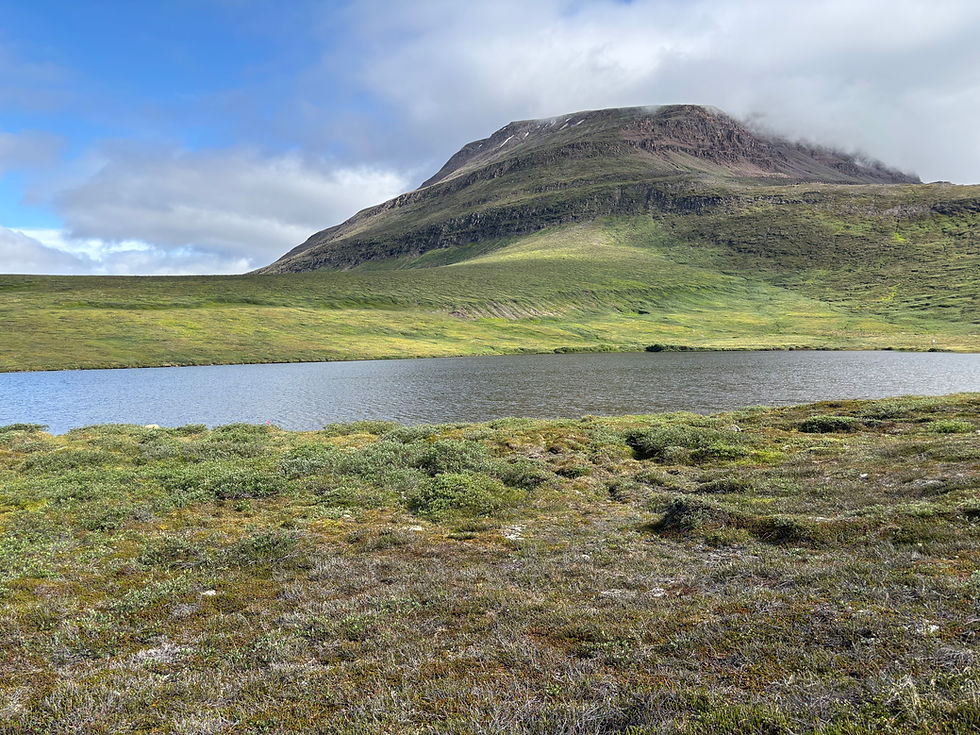
Kirsten and I set off from Arctic Station near Qeqertarsuaq on a gloriously sunny and warm July day to collect samples from Sanningasup Tasia (Morænesø), a designated FROST lake. Kirsten is an accomplished freshwater biologist with many years of Arctic research experience. I am new to this field, but excited to contribute to FROST’s collaborative dataset, while gaining additional practical field experience in freshwater sampling.
As we walked into the Arctic tundra, the mountain slopes rose above us, and the lake came into view. We trekked a few kilometers carrying our equipment in backpacks, except for the rubber dinghy, which had thankfully been left lakeside by a group of students working in the area. We brought everything needed to measure dissolved oxygen, temperature, conductivity, and pH, and to collect samples for particulate organic matter, phytoplankton, zooplankton, and mercury analysis.
During this trek, I had a chance to reflect on the relationships that Kirsten had developed over the years with the surrounding community. Each day we were in Qeqertarsuaq, a village of 800 inhabitants, she was greeted warmly and enthusiastically by community members who stopped to chat. It seemed indicative of a long-term relationship that had been built on trust and friendship between researchers and the local community. I thought about how important these relationships can be in creating a shared understanding of environmental change and how it can influence future community responses.

After returning to the station with a considerably heavier load, we spent the next day and a half preparing our samples for further analysis. Following the protocol provided by FROST to ensure consistency across all lakes within the study, we filtered, preserved, and labelled our samples in preparation for transport to project partners at University of Laval in Canada and University of Helsinki in Finland.

At this early stage in my career, it was especially meaningful to take part in this FROST project. This experience connected scientific theory with practical research, while also demonstrating how scientific evidence, along with long-term community relationships, can contribute to understanding environmental change and help inform future decision-making.


